The enclosure line in a research budget is often a guess made before anyone has drawn the housing. This post explains how the price of a custom enclosure is built when there is no mold, which design choices move it, and how to write a budget line that survives two prototype rounds and a design change.
We publish one reference figure, and it is a reference, not a quote: a prototype ABS enclosure of about 8 × 5 × 2 in runs around $500. Your number depends on your design, and a real quote comes back within 48 hours.
What you pay for when there is no mold
An injection-molded housing carries two prices: the mold, which takes at least 8 weeks to make and is paid for before the first part exists, and a piece price that pays the mold back over thousands of units. A fabricated housing has no mold, tooling or jigs. The quote contains only the work done on your parts: CNC time to machine the flat pattern, saw time to score the bends, bender time to fold them, labor to install inserts and solvent-bond the joints, any printing or coating, and the sheet consumed.
Engineering is included in the prototype price: the SolidWorks model, the review against our design rules and the files in your format. The design belongs to you. For a grant, that means there is no tooling item to justify and nothing to amortize; spending follows the units you order. The full breakdown is on our custom enclosure cost page.
How quantity changes the unit price
There is no minimum order. One or two units carry a setup charge, so the unit price is highest there. From 100 to 10,000 units the process is at its most economical. If your program looks like a pilot of three units followed by a study build of forty, ask for prices at both quantities in the same request, and add the number a follow-on study might need.
When units are needed across the life of a grant, a blanket order of 10 to 10,000 units gets volume pricing without receiving everything at once. Deliveries follow a schedule you set, monthly, quarterly or annually, and each unit is cut from the same program.
What drives the price of one enclosure
Each item below adds machine time, labor or material. All of them are checked in the engineering review, and the engineer will suggest the cheaper version where it costs you no function.
| Driver | Why it adds cost | The cheaper choice |
|---|---|---|
| Size | More sheet and longer machining; bends are limited to 40 in, so bigger housings need extra pieces | Size to the contents plus service clearance, not to a round number |
| Piece count | Each piece adds machining, edge routing and a bonded joint; an average enclosure has eight pieces in two thicknesses | Fold more, bond less |
| Machining on both faces | Reverse-side features double the labor on that piece | Keep each sheet’s features on one side |
| Inserts and bosses | Brass inserts cost more than self-tapping bosses | Inserts only where a screw comes out repeatedly; combine bosses |
| Openings | Rows of round holes cost more than a slot pattern | Vent slots, 2 mm minimum width |
| Material | Flame-retardant grades, polycarbonate and thicker sheet cost more than stock ABS | General-purpose ABS, which covers 80 percent of what we make, unless a rating requires otherwise |
| Color | A custom color needs around 2,000 lb of sheet | White, black, light grey or dark grey, with printed accents or two-tone panels |
| Finishes | Printing, painting and EMI coating are each an added operation | Only the operations the device needs, each priced as its own line |
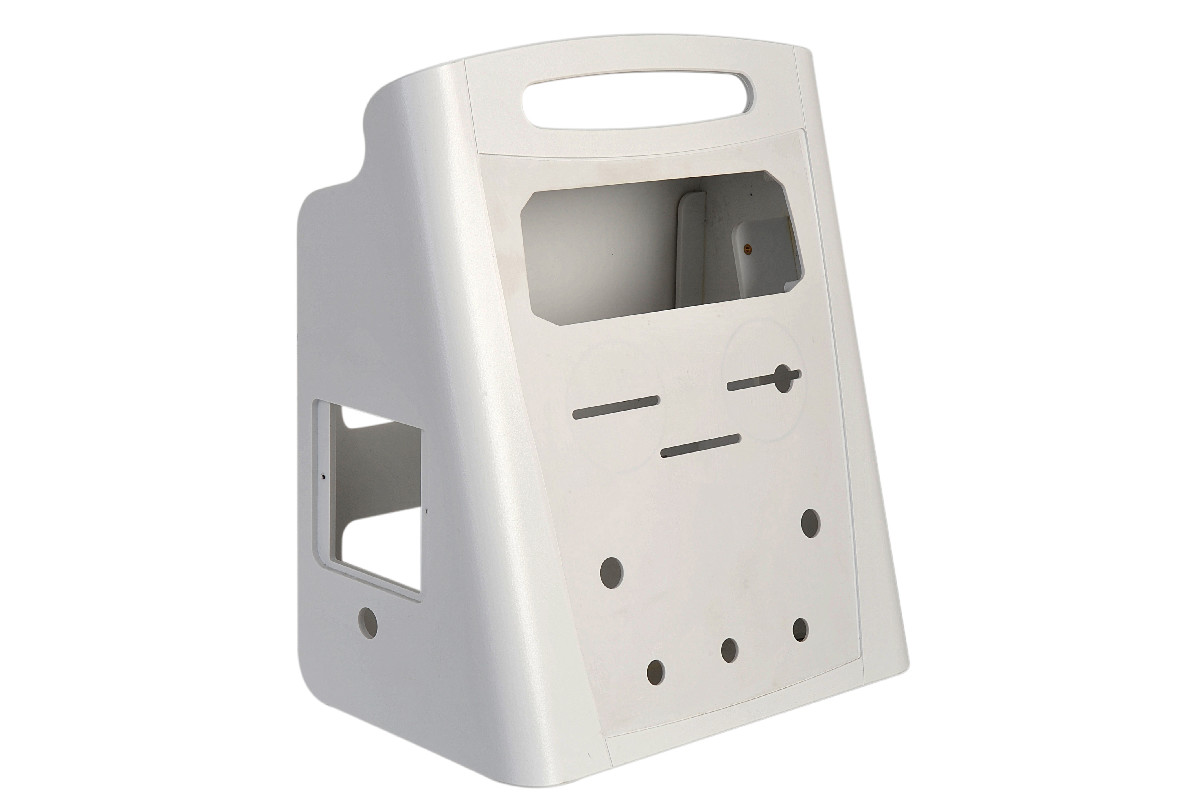
Most of these are fixed at the modeling stage, which is the cheapest time to change them. Our post on designing a plastic enclosure for cost goes through each one at the CAD level.
What revisions cost
Research hardware changes between builds, and a no-mold process prices that differently. Most changes are edits to the CNC program: a moved connector, a larger display cutout, an extra vent. Depending on complexity there is frequently no charge, and where there is one it is small next to modifying a mold. Simple changes can be picked up during a production run.
Changes to the structure cost more, because they need a new model review and usually a new prototype: a different size, an added piece, a new material or gauge. In our amplifier enclosure project the material moved from 3 mm black ABS to 1/8-inch light grey Boltaron after the first prototype, and a second prototype was the right call even though the wall grew by only about 0.2 mm.
Writing the enclosure line in a grant budget
- Get a quote before you submit. Send the board, a sketch or a model; an engineer replies within one business day. Ask how long the pricing holds, since awards can take months.
- Price two prototype rounds. The second is often a small program edit, but a material or size change means a full new prototype.
- List quantities by phase. Pilot units, study units and spares, each priced separately, because the setup charge makes a one- or two-unit pilot the most expensive per unit.
- Show finishes as separate lines. A reviewer can follow “UV-printed legends” or “V-0 material” more easily than one lump sum.
- Order spares with the study build. A few extra housings in the main run cost less per unit than a single replacement later, which carries its own setup charge.
- Put the dates in. Prototypes take 3 to 21 working days after model approval, and production ships three weeks after a purchase order. If funds must be spent within a budget period, a blanket order can place the deliveries inside it.
When a custom enclosure is not the cheapest answer
For one or two units that will never leave the bench, a catalog project box drilled in your own shop costs less than any custom housing. If the board suits a simple rectangular box, our pre-designed C Box and U Box enclosures sit in between: proven designs resized to your board, with the two-piece C Box the most economical enclosure we make.
At the other end, a mold starts to make sense for a stable design built in runs past roughly a thousand pieces. If your device is headed there, a fabricated run is still useful while the design settles; some customers build several runs of 500, revising between them, before they release tooling.
To put a real number in your budget, send the board or a sketch with the quantity for each phase through our request-for-quote form.