A plastic housing lasts in a process plant when two decisions are made correctly: the sheet is chosen for the chemicals, sunlight and temperatures it will meet, and every opening is designed for the ingress rating the finished device must carry. Wall thickness, color and fasteners follow from those two.
Below, each exposure in turn, with what it changes in a sheet-fabricated housing and where fabricated plastic is the wrong choice. Mounting, cable entry and service access are covered in process control housings designed for installation and service.
Write the environment down before the model
Start with the exposures nobody thinks to mention: the caustic washdown at the end of each shift, the afternoon sun on a south wall, the steam line a foot away. Put them on one page and send it with the CAD model. Each line drives a specific decision.
| Exposure | What it decides | Starting point |
|---|---|---|
| Cleaners and process chemicals | Sheet material; which seams face the spray | ABS for water-based cleaners; Boltaron 4335 where ABS is marginal; test the real chemical |
| Direct sunlight | UV protection and color | UV-stabilized polycarbonate for clear parts; protected or weather-grade sheet for the body; light colors |
| Temperature range | Material heat limit, expansion allowances, vented or sealed | Data-sheet heat limit against the hottest internal surface |
| Water and dust | Lid, cutout and vent design | The IP code the finished device must meet |
| Fire | UL 94 class of the body | Royalite FR ABS or Boltaron 4335, both UL 94 V-0 |
| Explosive atmosphere | Whether plastic is allowed at all | The hazardous-area classification, raised at the first conversation |
Chemicals and washdown: test the bent part, not the chart
Most chemical-resistance charts rate flat, unstressed samples. A fabricated housing is not unstressed. Every bend was formed hot, every joint is solvent bonded, brass inserts are heat-staked into bosses and screws clamp the lid. Environmental stress cracking starts where stress and chemical meet, so a sheet that passes on the chart can craze along a bend line or around an insert.
The useful test is a sample cut from the real program, bent, bonded and fitted with an insert, then wiped or soaked with the cleaner at the concentration and temperature the plant actually uses. As starting points:
- ABS handles water, detergents and dilute acids and alkalis well. Ketones, esters and chlorinated or aromatic solvents attack it; acetone dissolves it.
- Polycarbonate is tough and clear but weak against strong alkalis such as caustic washdown, against ammonia and amines, and against many solvents.
- Acrylic windows can craze where alcohol meets a stressed edge, so try alcohol wipes on a bonded sample.
- Boltaron 4335, an acrylic/PVC alloy rated UL 94 V-0, lists chemical resistance among its strengths and is the first alternative when ABS is marginal.
Every stocked sheet, with its data sheet, is on the materials page.
Sunlight, heat and expansion
Unprotected ABS is an indoor material. In direct sun it discolors and its surface turns brittle over time. Outdoors there are three routes: UV-stabilized polycarbonate (we stock TUFFAK GP) where the part is clear or must take impact; ABS protected by a paint finish, which we apply as a secondary operation; or a weather-grade sheet such as ASA-capped ABS, which is not on our stock list but can be considered, since any thermoformable sheet can be. Acrylic OPTIX is weather resistant and suits windows.
Sun also adds heat. A dark housing in direct sun runs well above air temperature, so outdoor units should be white or light grey, or carry a separate sun shade with an air gap behind it, which is one more flat-pattern part.
For heat from inside, compare the heat deflection temperature on the data sheet with the hottest internal surface (the power supply, a regulator, a heater), not with room temperature. Polycarbonate tolerates more heat than ABS. Plastic also conducts heat poorly: a metal enclosure spreads heat through its walls, while a sealed plastic one sheds it only from its outer surface. If the electronics need vents, the vents set the ingress rating, so settle the power budget first.
Expansion is easy to overlook. ABS expands roughly six to nine times as much as steel per degree, so a 400 mm ABS panel that sees a 50 °C swing changes length by about 1.5 to 2 mm. Fix a long plastic housing to a steel backplate with slotted holes at one end, and leave clearance around windows and gaskets.
Reading an IP code correctly
The IP code defined in IEC 60529 has two digits. The first covers solid objects and access to hazardous parts; the second covers water. The levels that come up most in plants:
- IP5X dust-protected: some dust may enter, but not enough to interfere with operation. IP6X dust-tight.
- IPX4 splashing water from any direction.
- IPX5 water jets; IPX6 powerful water jets.
- IPX7 temporary immersion, typically 1 m for 30 minutes.
Three points are often misread. Jets and immersion are tested separately, so an IPX7 product is not automatically IPX6; a product meant for both carries both, as in IP66/IP67. NEMA types (NEMA 250, UL 50E) are not a translation of IP codes, and some add tests such as corrosion and icing that IP codes do not cover. And a rating belongs to the tested assembly, with its glands, connectors and gaskets, never to a sheet material.
Vents set a ceiling. Our minimum vent slot is 2 mm wide, which keeps out the 2.5 mm probe of IP3X but not the 1 mm wire of IP4X. Open slots rule out IP6X.
Sealing a fabricated housing, and where it stops
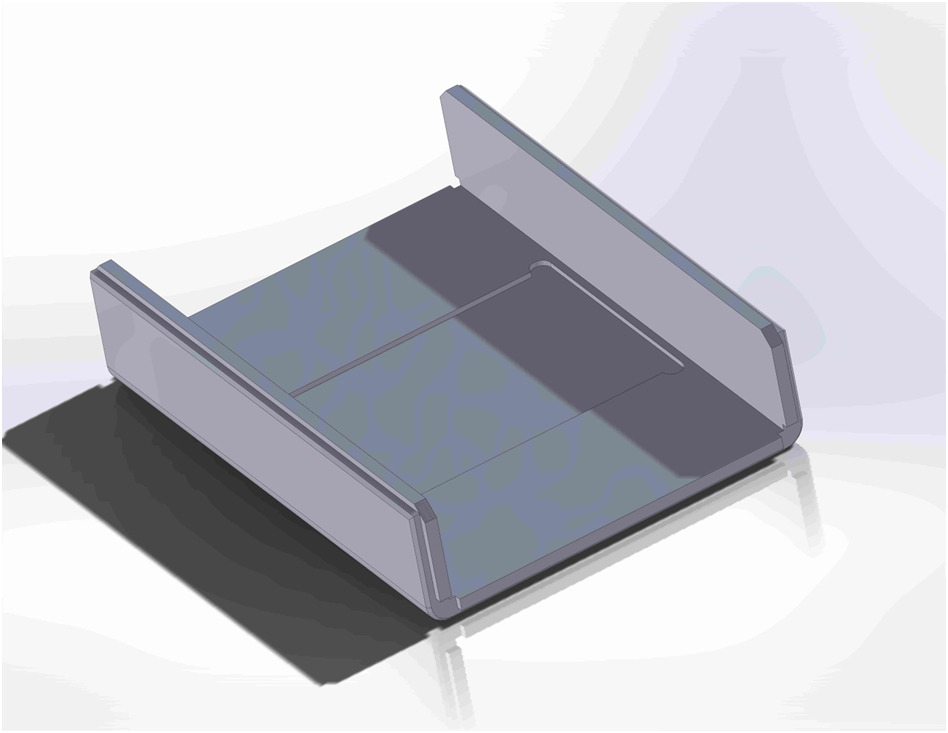
In a sheet-fabricated housing the bends are continuous sheet and the joints are solvent bonded rather than screwed together. Most of the sealing design goes where the housing opens or is pierced: the lid or door, each cutout, each screw through the wall and each vent.
- Lids and doors. A gasket needs a flat, continuous land and even compression. A 3 mm lid bows between screws and unloads the gasket; step the lid up to 6 or 8 mm, add a stiffening frame, or space the screws closer. A thick lid can carry a machined channel that locates the gasket.
- Fasteners. Lid screws go into heat-staked brass inserts, because the lid will be opened many times. Blind inserts in bosses are better than fasteners that pass through the outer wall.
- Cutouts. Specify connectors and cable glands that carry the rating you need, and give each a flat face, a wall thick enough for its nut and room for a wrench.
- Breathing. A sealed box pumps air as it warms and cools. A pressure-equalizing membrane vent stops it drawing moist air past the seals.
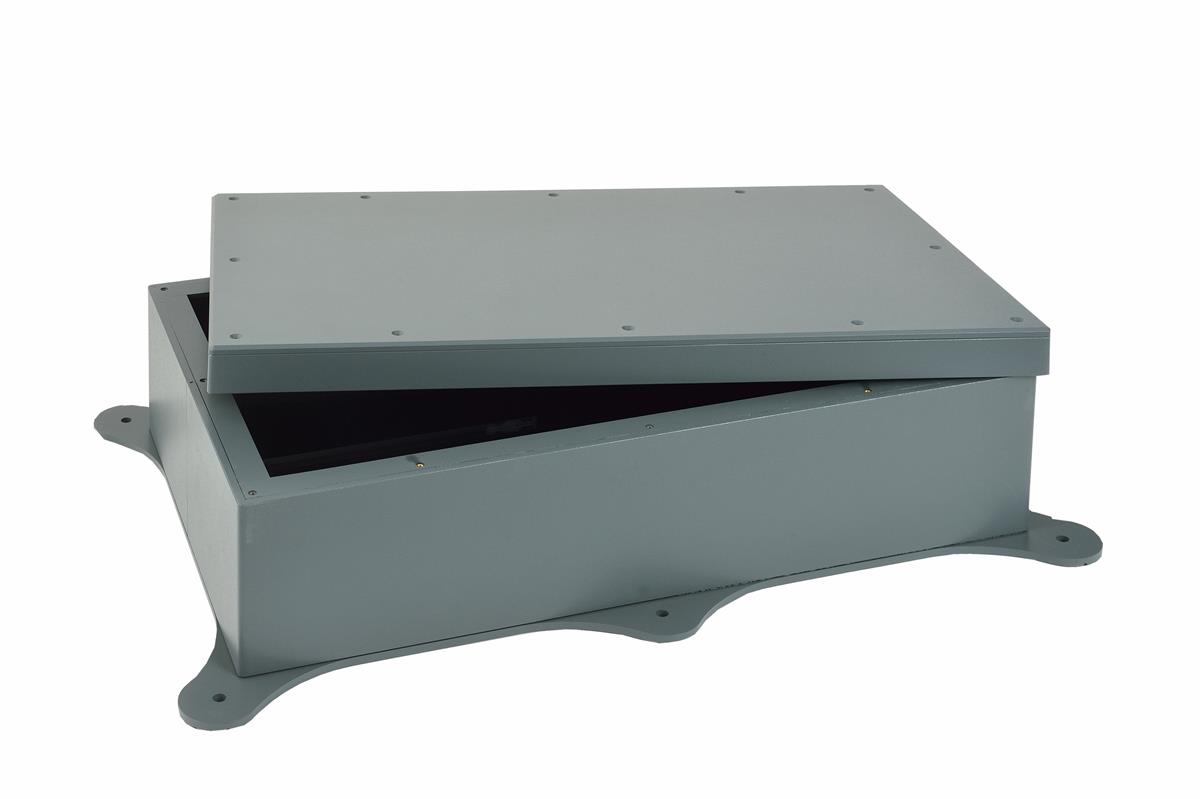
The limits are real. We do not publish IP ratings for our housings: ingress protection depends on the whole design, is discussed with an engineer at quote stage, and is proven by your test of the finished device. For a large door that must stay sealed through years of opening in a washdown zone, or for continuous immersion, a molded or stainless-steel enclosure with a purpose-made gasket channel is often the better answer, with a fabricated plastic housing used for the instrument inside it.
Flame classes and hazardous locations
UL 94 classes describe how a plastic sample burns in a standard flame test. HB is a slow horizontal burn. V-0 means a vertical sample stops burning within 10 seconds of the flame being removed, and any drips do not ignite cotton placed below. General-purpose ABS, polycarbonate TUFFAK GP and PETG are HB. When the housing is the fire enclosure around mains circuits or a large battery, the product safety standard sets the minimum class; for measurement, control and laboratory equipment that is usually IEC 61010-1 (UL 61010-1 in North America). The two V-0 sheets we stock for electrical enclosures are Royalite flame-retardant ABS (3 mm, black or white) and Boltaron 4335. A UL 94 rating is listed at a thickness, so check that your gauge is covered.
Hazardous (classified) locations are a separate question. Explosion-proof enclosures, which must contain an internal explosion, are almost always metal. Other protection methods can use plastic housings, but the hazardous-area standards add their own material rules, including limits on static charge on plastic surfaces, and the device maker certifies the complete product. If the device is headed for a classified area, say so first; it can rule out a plastic outer housing before any design work.
Send the environment page with your model through the request-for-quote form: chemicals, temperature range, mounting, IP target and flame class. An engineer replies within one business day and confirms the material before quoting.