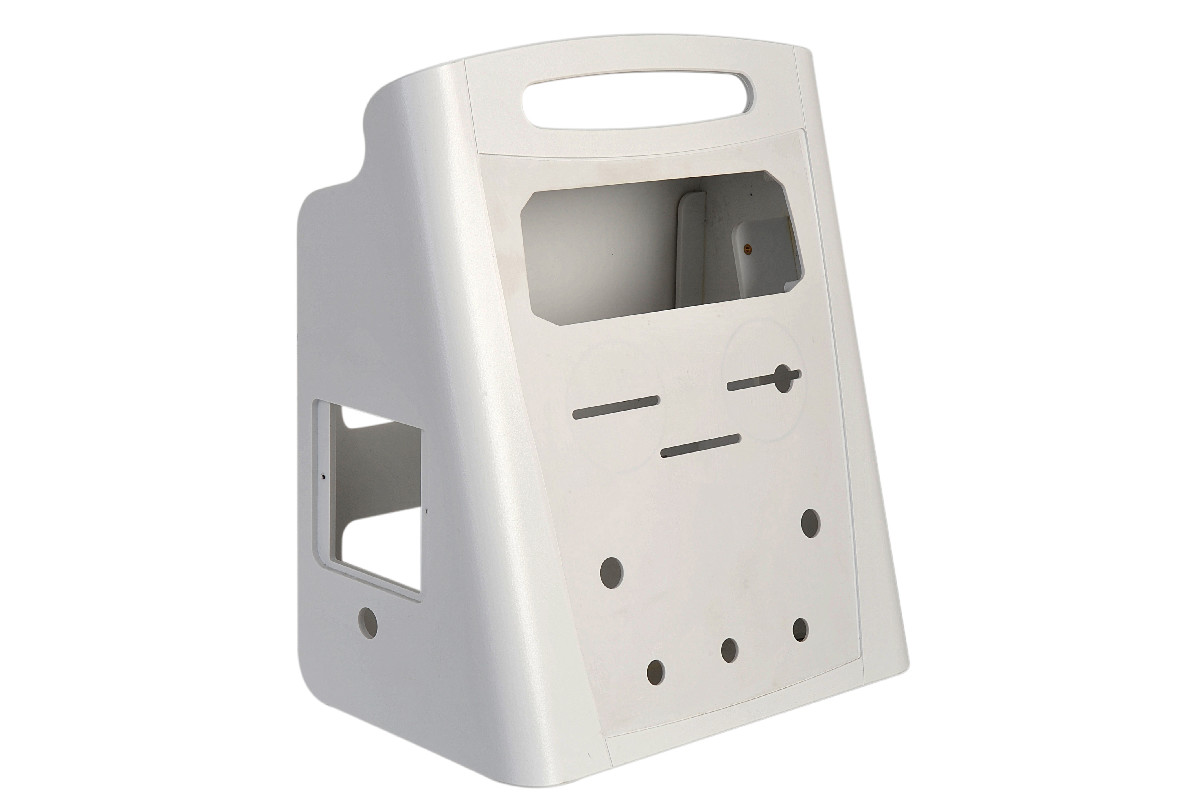
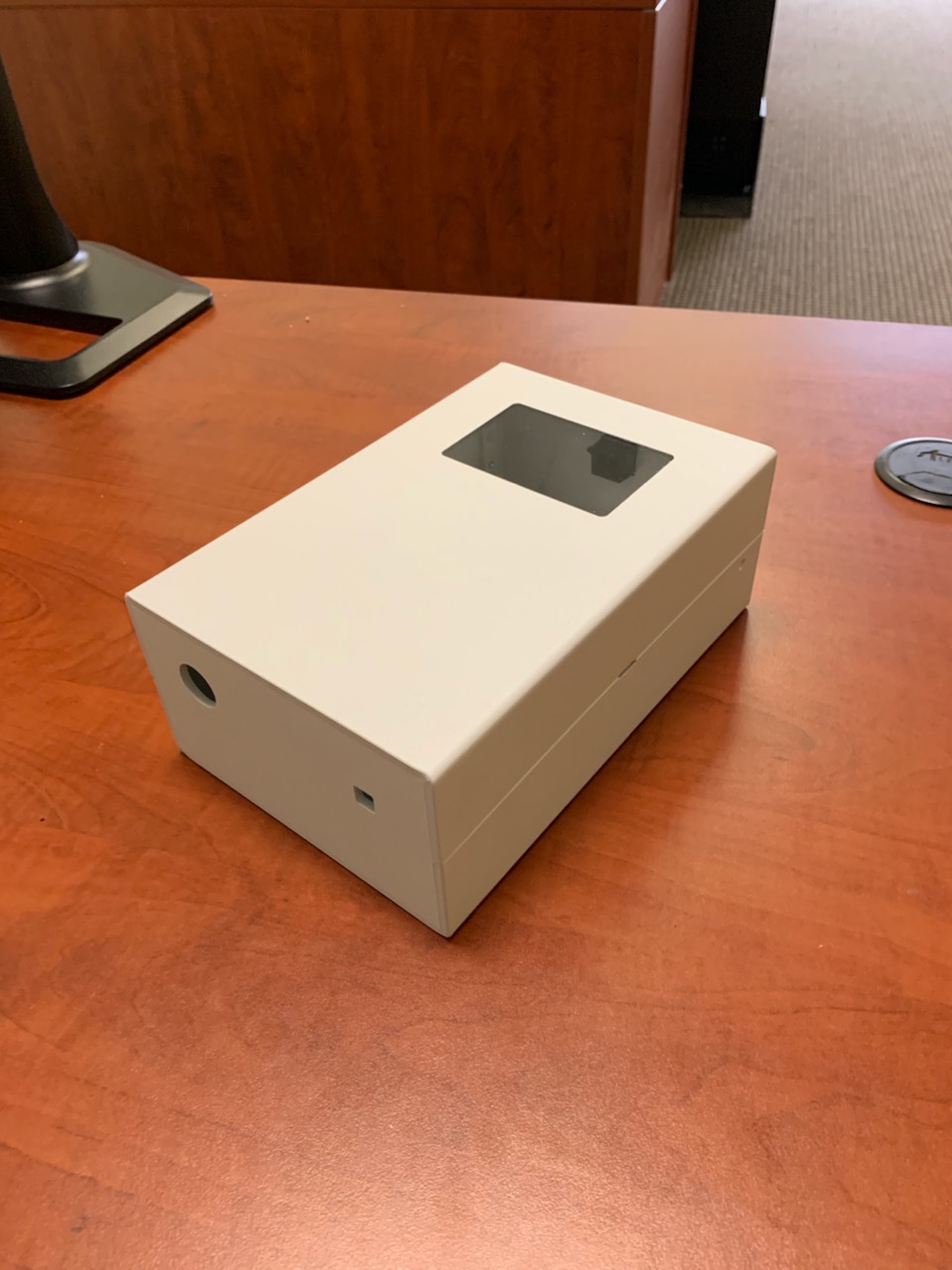
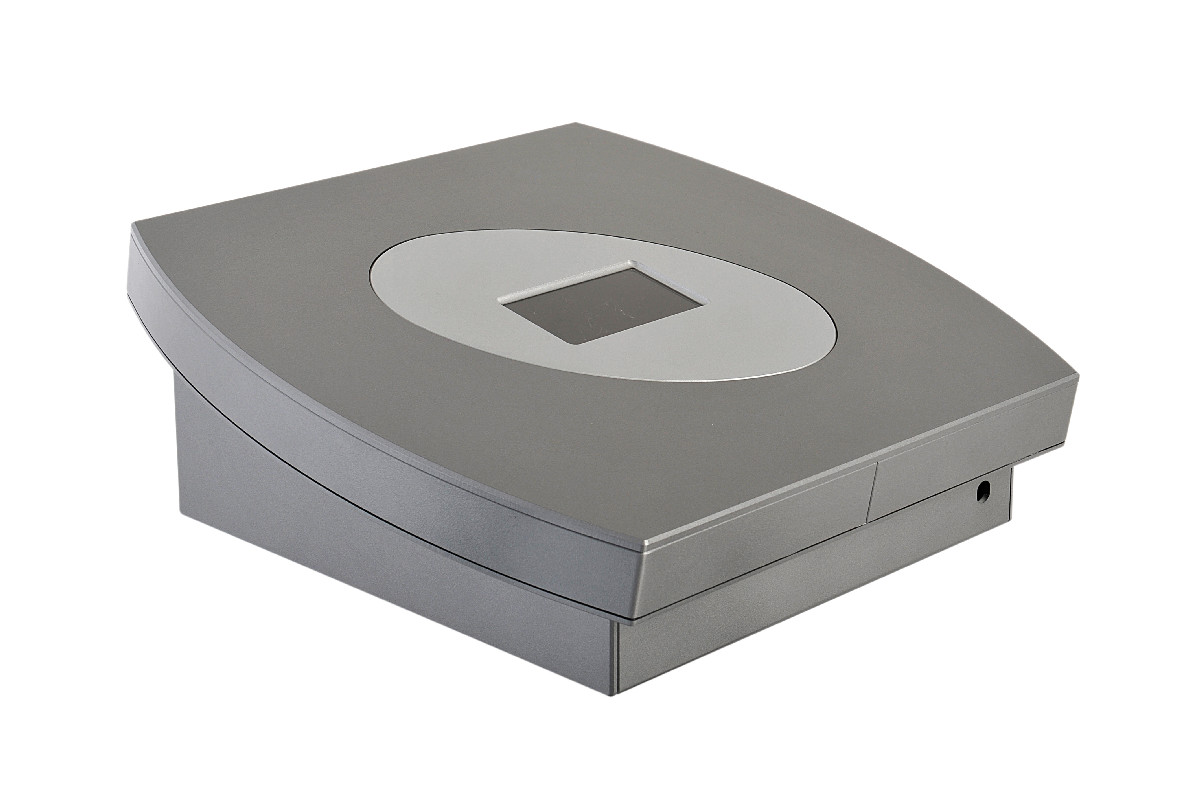
A headbox beside the pillow, an amplifier on the bedside shelf, a recorder in a pouch on the patient’s chest: patient-side sleep and neurology devices live within arm’s reach of someone asleep. That narrows the material choice to five questions: weight, edges, the chemistry used to clean between patients, flame rating and appearance. A sixth, biocompatibility, belongs to the device maker, and the last section explains why. How these devices fit together in the room is covered in our overview of sleep study equipment enclosures.
Start from general-purpose ABS and justify each change
About 80 percent of what we build is general-purpose ABS (ALLEN 552/LXS, UL94 HB), stocked in white, black, light grey and dark grey at 3, 4, 6 and 8 mm. It is tough, light, solvent bonds well and costs least. For a bedside device it is the right starting point, and every move away from it should answer a named requirement: a flame rating, a clear window, a chemical the lab uses. The stocked sheets and their data sheets are on our materials page.
Weight: the gauge matters more than the polymer
Engineers chasing weight tend to compare resins first. Work the numbers on a 200 × 150 × 60 mm housing, which has roughly 1,020 cm² of wall:
| Wall | Typical density (g/cm³) | Approximate shell weight |
|---|---|---|
| ABS, 3 mm | 1.05 | 320 g |
| Polycarbonate, 3 mm | 1.20 | 370 g |
| PETG, 3 mm | 1.27 | 390 g |
| ABS, 4 mm | 1.05 | 430 g |
One gauge up in ABS adds more weight than a switch to any of the denser clear plastics. Flame-retardant ABS and acrylic/PVC alloys such as Boltaron are also denser than general-purpose ABS, so check the data sheet before assuming a V-0 version weighs the same. For a headbox hung from a bed rail or a recorder worn overnight, keep walls at 3 mm and get stiffness from bends, ribs and corner doublers rather than from thicker sheet.
Edges and surfaces within reach of a sleeping patient
Nothing at the bedside should have a sharp corner, and in a bent-sheet housing many corners are bends. A 90-degree bend has an outside radius of one material thickness, so 3 mm on 3 mm sheet. Cut edges are routed to a standard 1, 2 or 3 mm radius, with one limit: 3 mm sheet takes at most a 2 mm radius, because the router bearing needs a flat land to run on. For a larger soft shape, such as the front of a bedside unit, we roll a curve in one direction. The enclosure design guide has the rest of these numbers.
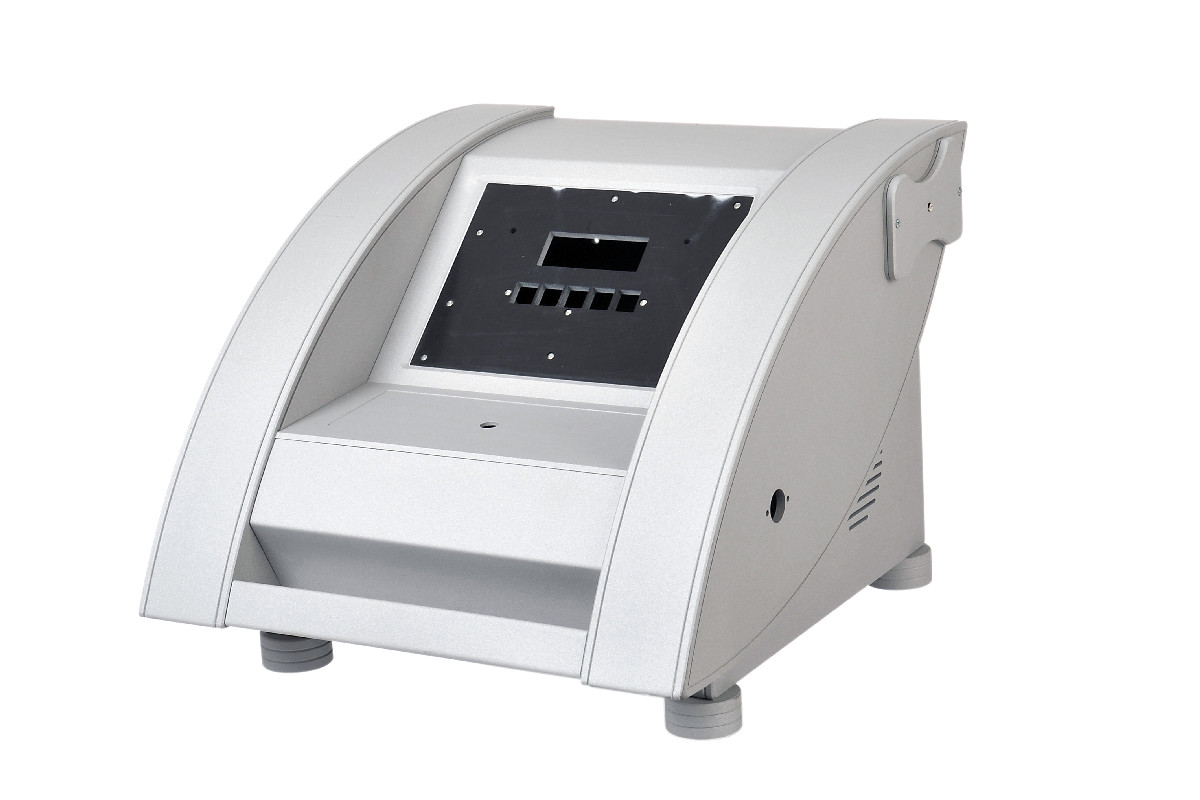
Surface texture is a trade-off. Pre-textured sheet hides the scuffs a device collects on a nightstand, but a coarse texture holds electrode paste and gel in its valleys. Tell us which faces are handled with gel on the gloves; a finer texture on those faces cleans faster.
Cleaning between patients: list every chemical in the room
Every patient-side housing is wiped after every study, usually with a hospital disinfectant based on quaternary ammonium, alcohol, diluted bleach or hydrogen peroxide, depending on the facility. EEG work adds two more. Electrode paste and conductive gel are water-based and wipe off. Collodion, used to hold electrodes for long recordings, is removed with acetone, and acetone dissolves ABS and attacks acrylic, polycarbonate and the other amorphous sheets used for enclosures. None of them is a good partner for it, so the practical answer is procedure: keep acetone and acetone-soaked gauze off the equipment, and print a caution on the housing if staff need reminding.
Disinfectants are subtler. Amorphous plastics, polycarbonate and acrylic especially, are prone to environmental stress cracking: a wipe that leaves a flat sample untouched can craze the same material where it is under stress. In a fabricated housing the stressed places are predictable: the bends, the bosses around heat-staked brass inserts and the solvent-bonded joints. Test there.
- Use the first prototype, which is cut from the same sheet and on the same program as production.
- Wipe it with the lab’s actual product, on its actual schedule, repeatedly over several weeks.
- Inspect the bends, inserts and joints for crazing or whitening, and the printed legends for fading or softening.
Boltaron 4335 is sold on its chemical resistance and is the first candidate to test where wipes are aggressive; PETG generally tolerates disinfectants better than polycarbonate. Your disinfectant maker’s compatibility list is a good way to choose candidates, not a reason to skip the test.
Flame rating: set by the device, not by habit
UL 94 HB means a horizontal sample burns below a set rate; V-0 means a vertical sample stops burning within 10 seconds of each flame application, with no flaming drips. Whether the housing must be V-0 follows from the device’s safety standard and your risk analysis, and it depends on the energy available inside. A mains-powered bedside amplifier is a likelier candidate than a low-power battery recorder.
We stock two V-0 sheets: Royalite flame-retardant ABS, in black and white at 3 mm, and Boltaron 4335, an acrylic/PVC alloy. Two details catch people out. A UL 94 rating applies at the thickness listed for that material, so confirm the listing covers the wall you design. And if the device should be neither stark white nor black, ask about Boltaron: the amplifier enclosure case study moved a device for brain-injury patients into 1/8-inch light gray Boltaron for a sturdier, more medical look.
Color and finish for a room built to look like a bedroom
Sleep lab rooms are usually furnished like bedrooms so patients sleep as they would at home, and the equipment should recede. Light grey hides handling marks better than white and shows less dust than dark grey or black. Matte, pre-textured sheet keeps reflections down when the lights are low. The color runs through the sheet, so a scratch shows the same color underneath instead of a paint chip.
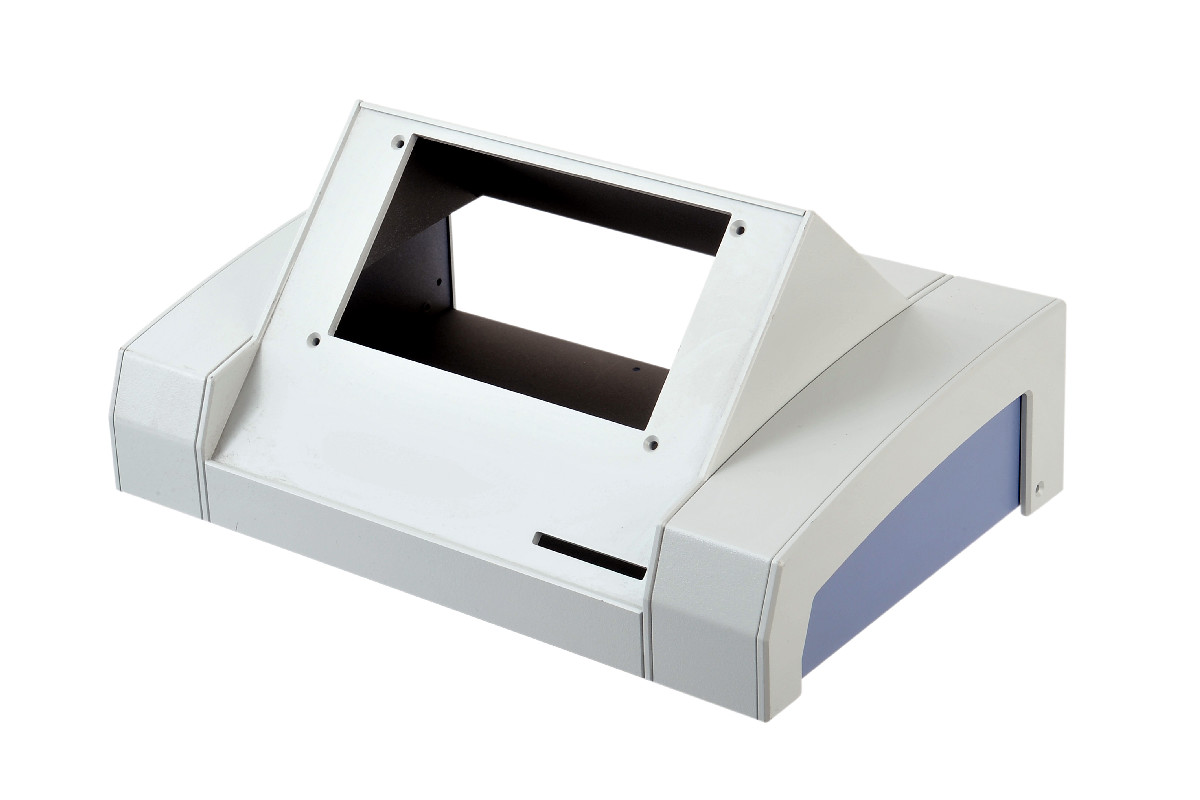
Two-tone panels from stocked colors, or a printed accent band, give a product its brand color without a custom sheet. A custom color needs around 2,000 lb of material, which at 3 mm is roughly 290 m² of sheet, enough for a couple of thousand housings the size of the example above. For a device built in hundreds, stocked colors and printing are the economical route. Indicator LEDs belong behind light pipes, where brightness and color can be chosen for a darkened room.
Biocompatibility is the device maker’s evaluation
Enclosure plastics are chosen for electronics, not for skin. Under ISO 10993-1, the biological evaluation is scoped by the kind of body contact and how long it lasts. A headbox or bedside unit that the patient does not touch by design sits at the low end of that scale. A recorder housing that rests on skin overnight is a surface-contact part and goes into your evaluation like any other.
That evaluation covers the finished part, not only the resin: in a fabricated housing, the sheet, the solvent-bonded joints, the UV-cured ink on printed faces and any conductive coating inside. We build in the grade you specify and do not certify materials for skin contact. Where contact is real, a fabric pouch or a separate skin-contact part between housing and patient is often the simpler path.
Tell us the cleaning agents and the flame rating, and an engineer will confirm the material during the engineering review. Request a quote with a model or a sketch, and the quote comes back within 48 hours.