A packaging OEM buys enclosures differently from a consumer-electronics company: small quantities, many variants, a machine that must be supported for years, and end customers who may ask about your suppliers. The right enclosure manufacturer is the one whose process, minimums, quality system and long-term support fit that pattern, not the one with the lowest price on a single quote.
This guide lists the questions to ask any supplier, with the answers we give at Toolless, including the cases where we are the wrong choice.
Start with the process, because it decides the rest
The process a supplier uses sets its minimum order, its lead time and the cost of a change before price is even discussed. Enclosure suppliers fall into four camps:
- Injection molders build a mold, which takes at least eight weeks, and then make identical parts cheaply. Right for thousands of units a year on a frozen design.
- Metal fabricators bend and weld sheet metal or stainless. Right for washdown zones, control cabinets and structural guards.
- Catalog suppliers sell standard boxes and machine openings into them. Right when a catalog size fits and the cutouts are few.
- Sheet plastic fabricators like Toolless machine, bend and bond plastic sheet with no tooling. Right for plastic housings from one unit to about 10,000, with variants and changes.
Our overview of how plastic enclosure manufacturers divide up the market goes into the trade-offs. For packaging equipment it often makes sense to use two suppliers: a metal fabricator for the wet and structural parts, and a plastic fabricator for the panels, controller housings and covers in the dry zones.
The questions to ask, with our answers
| Question | Why it matters to a packaging OEM | Toolless answer |
|---|---|---|
| What does it cost to start? | Tooling is spent before the first machine ships | No mold or tooling. A prototype ABS enclosure of about 8 × 5 × 2 in is around $500. |
| What is the minimum order? | Each machine uses only a few of each housing | None. One or two units carry a setup charge; most economical from 100 to 10,000. |
| How fast are the quote, prototype and production? | Machine schedules slip around long-lead parts | Reply in one business day, quote in 48 hours, prototype in 3 to 21 working days, production three weeks after PO. |
| Can releases follow our build schedule? | You do not want a year of housings on the shelf | Blanket orders of 10 to 10,000 units with scheduled releases. |
| Which materials and flame ratings? | Your electrical design may call for V-0 | ABS (HB); FR ABS and Boltaron 4335 (V-0); polycarbonate, PETG and acrylic. |
| What tolerance? | Panels must take catalog HMIs and push buttons | ±0.2 mm on the flat pattern, ±0.4 mm reverse to front. |
| What quality system? | Pharma and food customers may audit suppliers | ISO 9001:2015 through PRI Registrar, with an in-house quality lab. |
| Who designs it, and who owns the design? | You need models for your machine assembly | One engineer manages your job in SolidWorks and returns prt, igs, stp, stl or sldprt. The design is yours once the prototype is purchased. |
| What does a change cost? | Machines are revised mid-program | A program edit, frequently at no charge. |
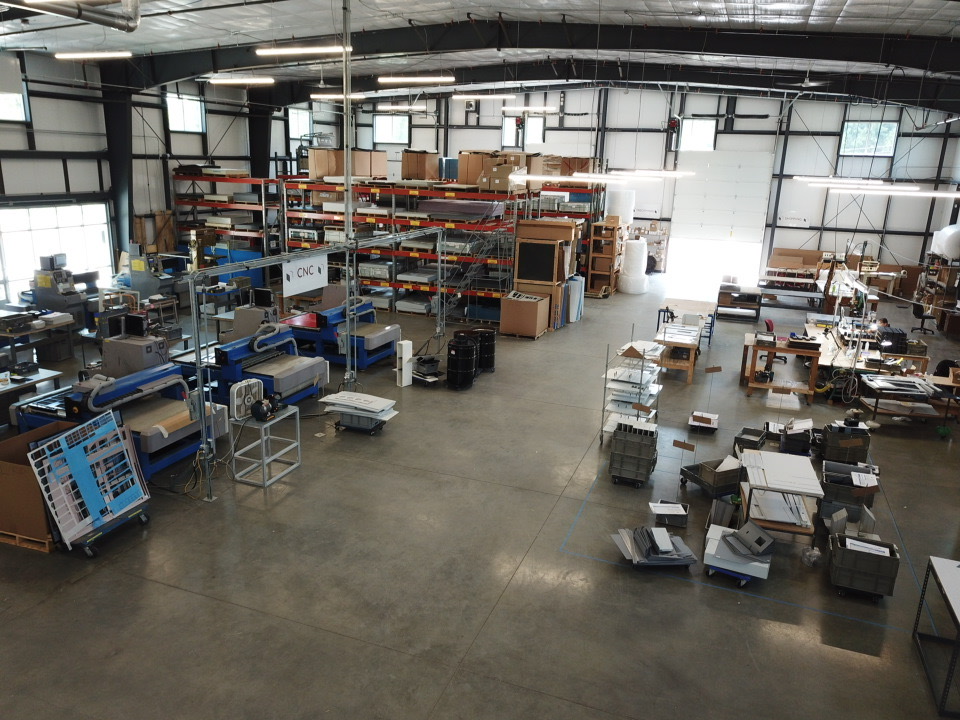
| Where is it made? | Visits and audits | A 13,000 sq ft plant in Everett, Washington, 20 miles north of Seattle. Visits by arrangement. |
Ask every supplier the same questions and compare the answers in one sheet. Vague answers on lead time and changes are the ones that cost you later.
Materials and flame ratings: ask for the paper
“Flame retardant” on a quote is not a specification. A UL 94 rating belongs to a specific material grade at a minimum thickness, and that thickness appears in the material’s UL listing. Ask which grade and thickness is quoted, and check that the listing covers the thickness and color you are buying.
Our stocked V-0 materials are Royalite flame-retardant ABS (3 mm, black or white) and Boltaron 4335, an acrylic/PVC alloy with good chemical and abrasion resistance, priced competitively with FR ABS. General-purpose ABS, polycarbonate and PETG are rated HB. The materials page links each manufacturer’s data sheet. Which rating your machine needs is a decision for your electrical design; we build the housing in the material you specify, and certifying the machine stays with you.
Quality and documentation to expect
An ISO 9001 certificate tells you a supplier runs a documented system. It does not tell you how your part is controlled, so ask three things: how the first part is approved, how revisions are tracked, and what is inspected on each lot.
Our answers: you approve a 3D model before any sheet is cut, and the prototype is made on the production equipment from the production program, so it serves as your first article. In assembly, a complete setup unit is built and checked by engineering before the rest of the lot is assembled, and every lot passes the quality lab before it ships. Our ISO 9001:2015 certification covers the whole Everett operation, from engineering to inspection.
Ask for references too. Customers on our testimonials page include IMA North America, Sensata and Halytech.
Spares over the life of the machine
Ask each supplier what happens when you order one cover in eight years. With a molded part, the answer depends on whether the mold still exists and who stores it. With a modified catalog box, it depends on whether the catalog still lists that size.
We make every order fresh rather than from stock, from the program that made the original, so a spare fits the machine it replaces. The flip side is that a spare carries a normal lead time, and an order of one or two units carries a setup charge. For covers that get damaged often, add a few to each blanket order release rather than ordering them one at a time.
When the answer should be “not us”
A good supplier tells you early when its process is the wrong one. Ours is the wrong one for the following, and where plastic fits on packaging machinery maps the boundary zone by zone:
- Housings in washdown or product-contact zones, which need hygienic metal design. We do not make metal enclosures.
- Main control cabinets, where a standard metal cabinet is cheaper and comes with its accessories.
- Many thousands of identical units on a design that will not change. Past roughly a thousand pieces per run, a mold pays for itself.
- Parts in the heat path of sealing jaws or shrink tunnels.
- Product packaging itself. We do not make trays, clamshells or blisters.
If your panels and controller housings fit the dry-zone profile, send a model or sketch with your yearly quantities through our quote request. An engineer will reply within one business day.