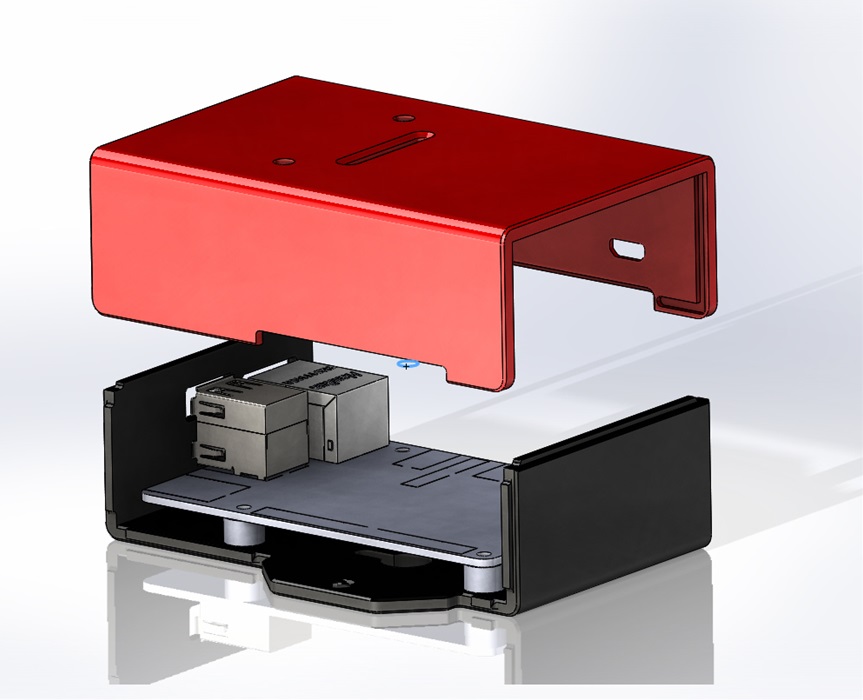
For a bare Raspberry Pi on a desk, buy a stock case. It is cheap, available immediately and fits the board it was molded for. A custom case earns its price only when the product has outgrown what the stock case was designed to hold, and that point is easy to recognize once you know the signs.
This post gives the five triggers we see most often, the situations where you should stay with a stock case, and the standard C Box and U Box designs that sit between the two.
What a stock case is designed to do
A molded Pi case is built around one board. It locates the Pi on its four M2.5 mounting holes, opens the standard connectors of that board generation, and the better ones deal with heat through a fan or a heatsink lid. Because it is molded in very large volumes, its unit price is far below anything a low-volume process can match.
That design has a fixed scope: one board, in one orientation, sometimes one HAT, and nothing else inside. Each trigger below is a way of leaving that scope.
Five reasons to switch to a custom case
1. There is more inside than the Pi
Products add HATs, a relay or signal-conditioning board, a DC-DC converter, a battery, a camera adapter and the cables between them. A stock case has nowhere to mount any of it, so the extras end up on double-sided tape, in a second box or behind a hand-drilled lid. Each of those is a likely field failure.
A custom case is designed around the full stack, with bosses or slots for every board and room for the cable bends. Our receiver box case study is typical: a Raspberry Pi 3B+ with a UPS HAT and a 2.8-inch touchscreen stacked on it, a CSI-to-HDMI adapter, a signal-conditioner board and a four-cell 18650 battery pack, all in one splashproof housing with a removable battery door.
2. The product has a display or front-panel controls
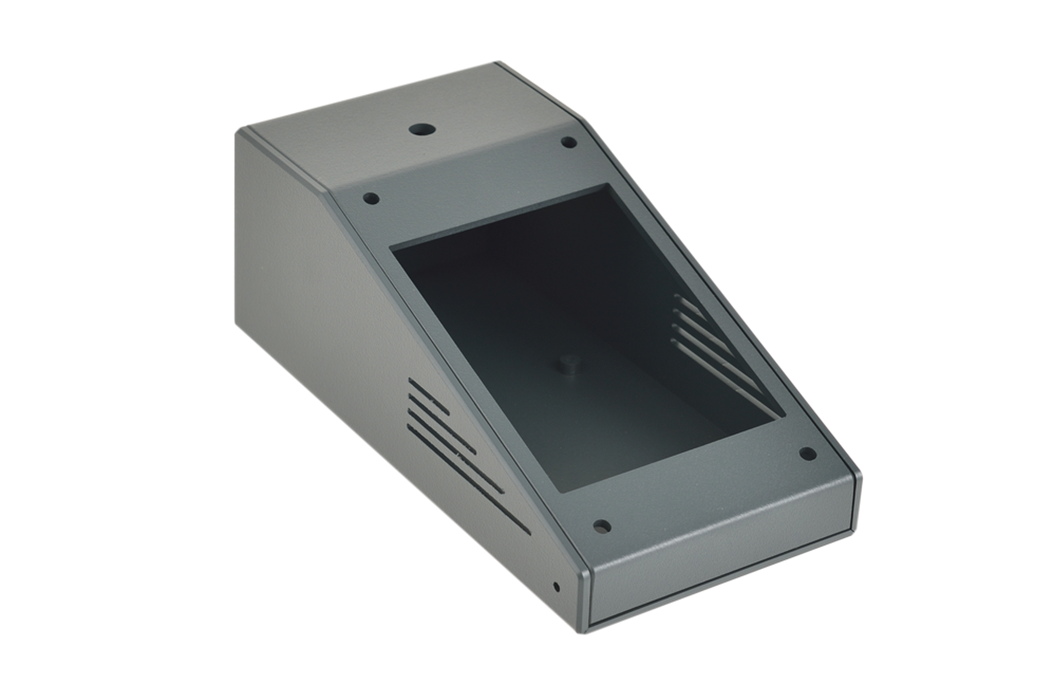
Once a touchscreen, buttons or status LEDs form the user interface, the case is the front panel. The screen needs a window at a chosen height and angle, the LEDs need light pipes to the surface, and the buttons need openings sized to their travel. A display bolted to the top of a stock case gives you whatever viewing angle the case happens to have.
In a fabricated case these are features of the flat pattern. The sloped face of a desktop console is folded on the thermal bender, the display opening is machined before the bend, and an acrylic window is solvent bonded into a recess from the rear. One of our custom Raspberry Pi cases sits a Pi 4 on four bosses with a display board above it, showing through a non-glare acrylic insert.
3. It will be mounted somewhere
A case on a desk only holds the board. A case screwed to a wall, a machine frame or a pole also carries its own weight, takes cable strain, and gets opened in place by someone who did not build it. Stock cases are designed for the desk, and their mounting options, where they exist, are generic.
A custom case can carry side flanges bent from the body sheet, brass inserts for screws that will be removed in service, or a 1/4-20 insert for a pole or camera mount. The load then goes into the enclosure wall instead of through the board’s standoffs. Our checklist for commercial Pi products covers mounting styles in more detail.
4. It carries your name
A stock case with a sticker on it reads as a prototype. If the case is the first thing your customer sees, the logo, the port labels and a place for your regulatory marks belong on the part itself. On a fabricated case they are printed in full color on the flat sheet before it is bent, or engraved, and the color comes from pre-colored sheet, so there is no paint to chip.
5. You are going to sell it for years
This is the trigger engineers most often miss. A product needs the same case on unit 1 and unit 1,000, and again when a customer orders a replacement three years later. A stock case belongs to its vendor, who can revise or drop it when the next board generation arrives. A custom design belongs to you, and every reorder is cut from the same CNC program, to ±0.2 mm on the flat pattern.
When your board changes, the case changes with a program edit rather than a new mold.
When to stay with a stock case
- One or two units of a bare board. A custom case at that quantity carries a setup charge. For scale, our published comparison puts a prototype ABS enclosure of about 8 × 5 × 2 in at around $500, and a stock case costs a small fraction of that.
- The electronics are not settled. Prototype the board stack in a stock case, or on a plate, until you know which boards go inside and which connectors face out. Then design the enclosure once.
- It never leaves the bench. Lab tools, classroom kits and internal test rigs rarely need more than a stock case.
- Very high volume on a frozen design. If you will build thousands of identical units per run and the design will not change, a mold pays for itself. We put the crossover at roughly a thousand pieces per run.
The middle path: a standard box sized to your board
Between a stock case and a fully custom housing sit our two standard designs. The C Box is two C-shaped halves joined by a snap-together tongue-and-groove. It is the most economical enclosure we make and our most common starting point for a Pi case. The U Box has four pieces (a U-shaped body, a cover and two end panels) and suits long, narrow or deep stacks that a two-piece shell does not.
Neither comes in catalog sizes. In the Product Designer you set length, width, height, sheet thickness and color, download a STEP or IGES model to check against your assembly, and send it back with your cutout notes. We add the openings and return a quote. For a product that has outgrown a stock case but does not need a sloped display face or a mounting frame, this is usually the cheapest route.
Stock, standard or custom at a glance
| Stock molded case | C Box or U Box | Fully custom case | |
|---|---|---|---|
| What fits inside | One bare board, sometimes one HAT | Your board stack, in a two- or four-piece box | Everything in the product, in any layout |
| Extra cutouts | Drilled by hand | Machined from your connector list | Machined from your connector list |
| Display and controls | Add-on, if any | Acrylic window in a face | Window, sloped face, light pipes, buttons |
| Mounting | Designed for a desk | Side flanges or inserts | Designed with the case: flanges, inserts, brackets |
| Branding | Sticker | Printed, engraved or two-color | Printed, engraved or two-color |
| Quantity | Any, from stock | No minimum; setup charge on one or two | No minimum; setup charge on one or two |
| Board revision | Find another case | Program edit | Program edit |
| Same part on every reorder | Until the vendor changes it | Yes, same program | Yes, same program |
Time and quantity
A stock case arrives in days and can be bought one at a time. A custom case starts with a 3D model that you approve before any sheet is cut. We reply to a request within one business day and quote within 48 hours. Prototypes take 3 to 21 working days depending on complexity, and Pi cases have gone from first contact to delivered parts in as little as 3 to 4 weeks.
There is no minimum order. The process is most economical from 100 to 10,000 units, usually delivered as scheduled releases under a blanket order, and each production run ships three weeks after its purchase order.
If your Pi product has hit one of the five triggers, send the board model (or just the board name), the list of add-ons and the quantity through our CAD upload page. An engineer will tell you whether a C Box will do or the product needs a fully custom case.